

❋
The Cost of Speed at Benevity
In a high-pressure SaaS environment, growth is the goal—but friction is the reality. During my tenure at Benevity, we scaled rapidly to support global marketing and product demands. However, we hit a systemic wall: the "SaaS Scale Paradox." As the volume of requests increased, the quality of project inputs decreased.
Leadership had the vision, but their inputs were often "High-Level & Low-Detail." This created Discovery Debt—a compounding tax on the creative team who spent 40% of their time acting as "Information Detectives" instead of designers. We were losing hours to vague Slack pings and misaligned kickoff meetings. I realized that to protect our output, I had to stop fixing the briefs and start engineering the machine.
Building the Creative Neural Briefing Engine
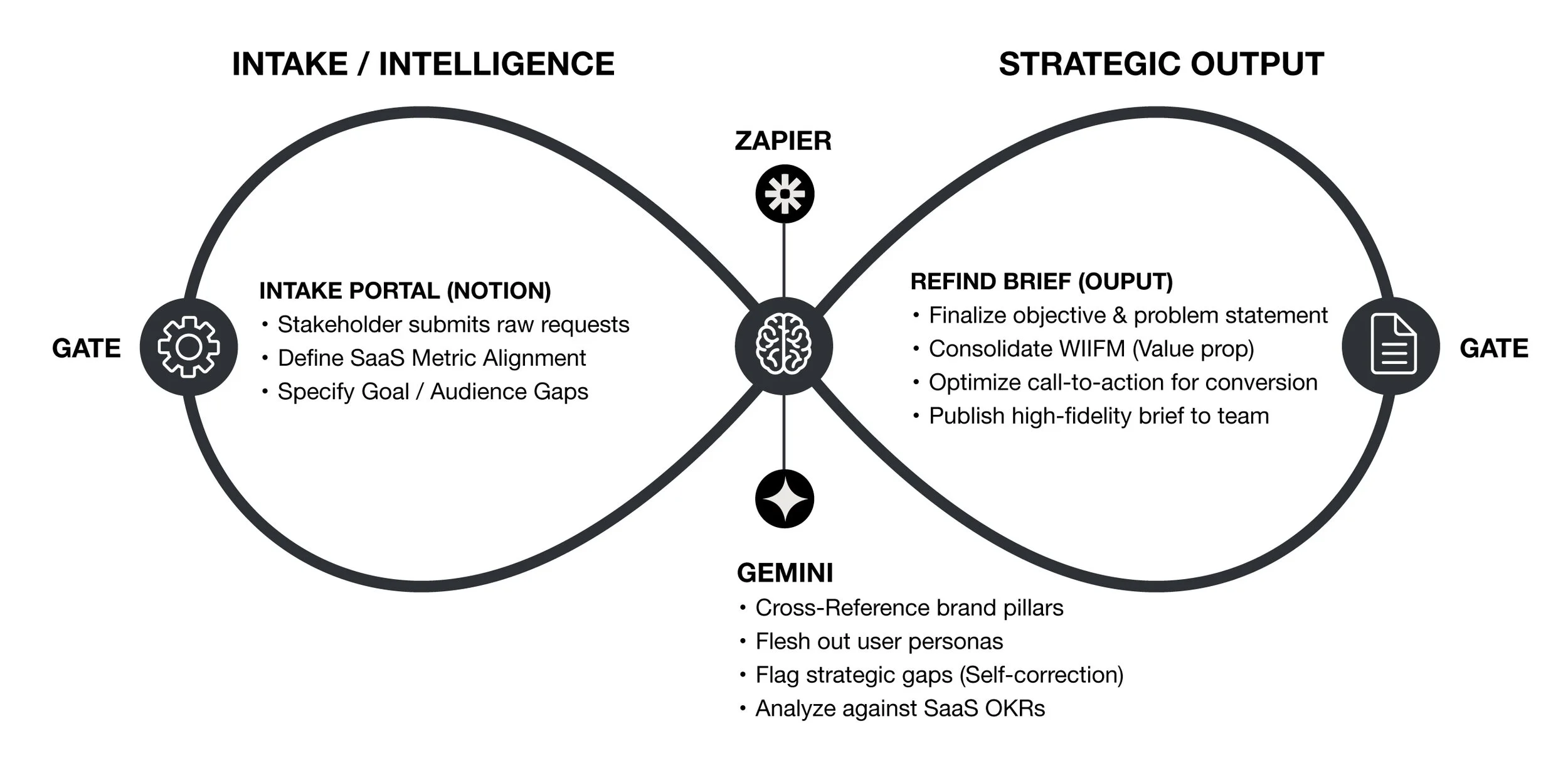
I designed a "Strategic Filter" using a custom stack that bridges the gap between executive intent and creative execution. This isn't just automation; it’s an Operational Product.
Notion (The Skeleton): A centralized, structured database that serves as the single source of truth for every marketing request.
Zapier (The Pulse): The automated nervous system that moves data instantly between platforms, eliminating manual hand-offs.
Gemini (The Brain): The AI layer that "interrogates" every request, vetting it against our brand DNA before a human ever touches a pixel.

❋
Moving from Summarization to Strategy
Most AI workflows simply summarize text. This system interrogates it. Using custom prompt logic, Gemini acts as a Senior Creative Strategist. It cross-references every inbound request against three specific SaaS pillars:
Metric Alignment: Does this support a core KPI (e.g., Retention, MQLs)?
Persona Accuracy: Is the target audience defined by their pain points, not just their job title?
The "Gap" Flag: If a request lacks a deadline, budget, or clear value prop, the system automatically flags "Critical Clarifications Needed."
The result is a brief that leadership feels ownership of, but carries the tactical clarity the creative team needs to win on the first round.
Engineering a Self-Correcting Ecosystem
The most powerful aspect of this architecture is the Loop. Unlike linear workflows that end when a project ships, this is a closed-loop system designed for Compound Operational Velocity.
By analyzing the "Strategic Gaps" flagged by the AI over time, we identify patterns in stakeholder friction. If a certain department consistently misses audience data, we don't just fix the brief—we update the Notion intake form and recalibrate the Gemini prompt logic. The system actually trains the organization to provide better inputs, making the 100th project significantly faster than the 1st.

❋
Results at SaaS Scale
By automating the "Initial Interrogation," we transformed the culture of creativity at Benevity.
70% Reduction in Kickoff Admin: We eliminated the "kickoff-of-the-kickoff" meeting.
Zero Information Gaps: 100% of briefs met "Executive Grade" standards before production.
Deep Work Protection: Designers reclaimed 10+ hours per week, moving from administrative churn to high-impact execution.

Designing Ecosystems, Not Just Assets
This project taught me that the modern Creative Director must be part-artist and part-architect. In a world of infinite content and rapid AI adoption, the bottleneck is rarely the "output"—it’s the clarity of the input.
By engineering this "Neural Briefing" system, the goal wasn't to replace the human element of creativity, but to protect it. By automating the logical, administrative, and strategic vetting layers of a project, we gave the humans back their magic. We moved from a culture of "reactive design" to one of "proactive strategy."
